
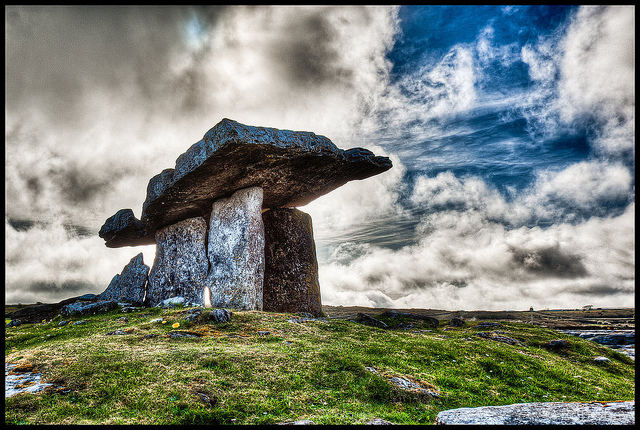
Standing proud in the stark landscape of the Burren Co. Clare, the iconic megalithic tomb at Poulnabrone is one of Ireland’s most photographed archaeological sites. Dating from the Neolithic period, this distinctive monument has revealed a wealth of information about the lives and burial customs of Ireland’s very first farming communities.
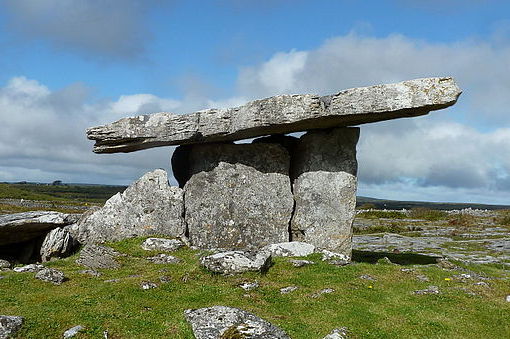
Poulnabrone is classified as a portal tomb by archaeologists, and there are approximately 174 of these monuments in the country. The majority are located in the northern half of the island, although outliers exists further south, especially in counties Clare and Waterford. The tombs generally consist of two large portal-stones defining the entrance and a back-stone, all of which support the roof-stone. The roof-stone can be of considerable size, with the largest example at Brownshill, Co. Carlow weighing circa 100 tonnes.
It is not known how these very large stones were moved and raised but it probably involved a combination of wooden rollers, ropes and man/animal power. It is possible that ramps of earth and stone were used to haul the large roof stones into place and some portal tombs have evidence for denuded cairns, which may have been used for this purpose.
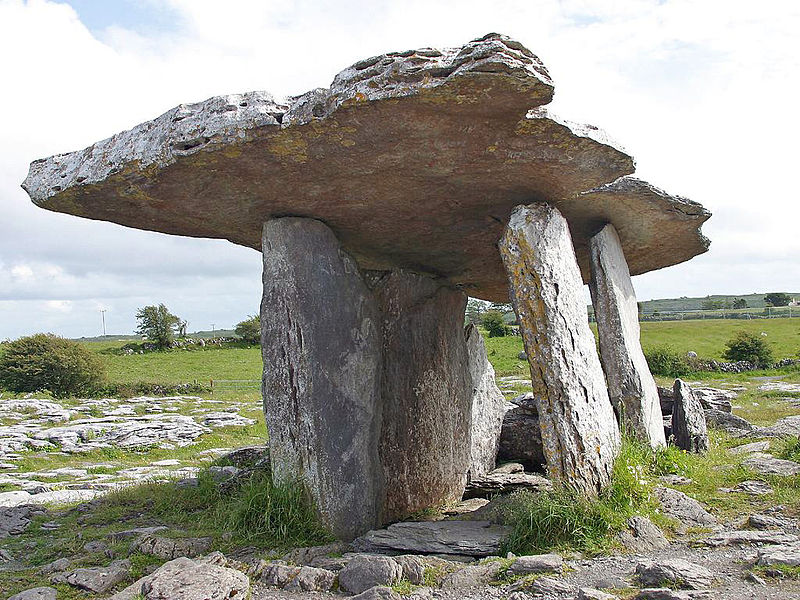
Poulnabrone represents one of the very few Irish portal tombs that have been archaeologically investigated. This excavation, which was carried out by Ann Lynch, uncovered the remains of twenty two people, sixteen adults and six children within the interior of the tomb. Of these bodies only eight could be sexed and these were equally split between males and females.
The bones were disarticulated and appear to have been placed within the tomb in a de-fleshed condition. This suggested a complex burial ritual, where the bodies were firstly stored or buried elsewhere until they decomposed. The bare bones were then transferred to the portal tomb for final interment. A number of the bones contained scorch marks suggesting that they had been held over a flame prior to burial, possibly during a purification ritual.
Specialist analysis of the skeletal remains have given us a remarkable insight into the lives of these Neolithic people. They appear to have experienced relatively short lives with only one person being older than 40. They also worked hard and were used to carrying heavy loads as evidenced by the arthritic condition of many of the neck and shoulder bones. Analysis of the teeth revealed that they suffered from periods of either malnutrition or infections, especially between the ages of three and six.
Evidence for violence was also encountered amongst the burial remains. A depressed fracture, possibly caused by a stone projectile was identified in one of the skulls, while a broken rib bone may have been caused by an aggressive blow. Even more startling, a fragment of a flint projectile point, probably and arrow head was found embedded in a hip bone. There was no trace of infection or healing so the wound must have occurred around the time of death.
The radiocarbon dates from Poulnabrone indicate that the burials were deposited at regular intervals over a period of 600 years between 3800 and 3200 BC. This suggests that the monument was probably a significant place of burial where only certain members of the community were allowed to be interred.
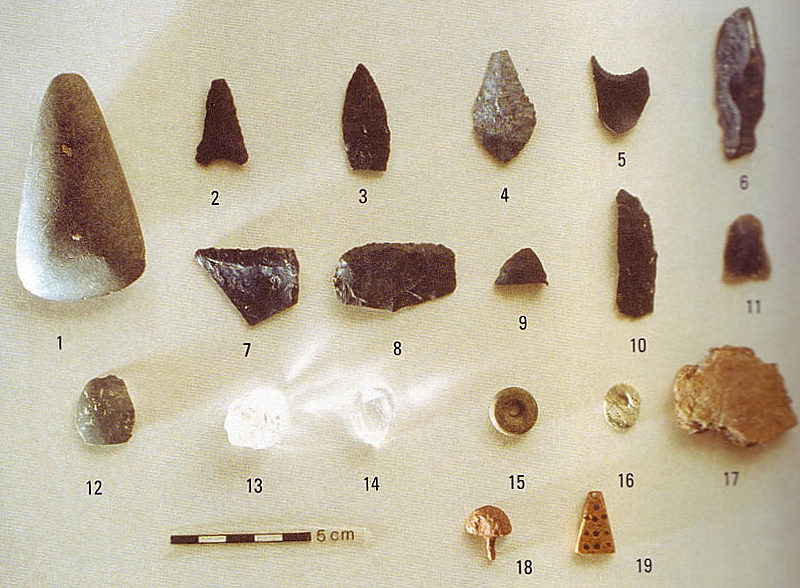
A variety of artefacts, presumably representing grave goods, were also recovered from the burial chamber. These included a polished stone axe, two stone beads, a decorated bone pendant, a fragment of a mushroom-headed bone pin, two quartz crystals, several sherds of coarse pottery, three chert arrowheads and three chert/flint scrapers.
Thus the burial evidence from Poulnabrone has given us rare glimpse into the lives of our early ancestors. It appears that they endured a relatively tough existence, that involved hard physical labour, childhood illnesses, occasional violent attacks and early deaths. Although only a small section of the community were deemed worthy of burial in the tomb, there is little evidence for gender or age discrimination, with both male and female remains present as well as young and old. Prior to interment their bones appear to have been stored elsewhere and this may indicate that they were venerated as ancestor relics. Why certain individuals were chosen to be buried in the seemingly exalted location of a megalithic tomb, however, remains a mystery.
References
Jones, C. 2004. The Burren and the Aran Islands:exploring the archaeology. Collins Press.
Waddell, J. 1998. The Prehistoric Archaeology of Ireland, Galway University Press
(originally posted by Irish Archaeology on Facebook)
The Burren is a fascinating area, with many archaeological sites, and is included in our Wild Atlantic Way tours!

 The Beara Peninsula is a hidden gem of Ireland, still very wild and pristine, authentic in every way. It is a favorite place of mine due to its rugged landscape, exceptional beauty, and fine people!
 Authentic Travel and Tours, LLC