 The Neolithic passage tomb at Newgrange is the most visited archaeological site in Ireland. Over 5000 years old it pre-dates the first phase of Stonehenge by 1000 years and the Egyptian pyramids by 400 years. It is a truly massive structure measuring 76 m in diameter by 12 m in height and it contains over 200,000 tonnes of earth and stone in its fabric. Indeed, it’s glistening façade of quartz is one of the country’s most memorable vistas. However, as the images below attest, Newgrange has not always looked so pristine.

1699: This image shows Edward Lhywd’s survey of Newgrange (after Stout & Stout 2008, p. 98, fig. 66). It is the first known plan of the tomb and it was drawn shortly after the entrance into the mound was rediscovered in 1699. Up until that date the entrance had actually been sealed and it was only uncovered again when the local landowner, Charles Campbell, began quarrying the mound for stones.
 1775: A view of Newgrange from c. 1775 by the noted antiquarian artist Gabriel Beranger. It shows a large mound of earth and stone that is nearly devoid of trees. Although a number of the standing stones which surround the mound are illustrated, the tomb entrance is not visible (it is shown in a separate drawing).
 1790: This engraving of Newgrange was included in Edward Ledwich’s Antiquities of Ireland, which was published in 1790 (after Stout & Stout 2008, p. 97, fig. 65). The mound is once again shown largely treeless and in this image the passage entrance can be clearly seen. A large triangular stone, which formerly stood directly in front of the entrance is also illustrated.

1892: A photo of Newgrange taken by George Coffey in 1892 (source). Unlike the earlier, 18th century depictions the mound is now covered in a thick scrub of trees and bushes.

Late 19th century: This atmospheric shot of the passage tomb entrance shows a man emerging from its dark interior. It was taken by R. J. Welch sometime in the late 19th century and it shows an overgrown and partially disturbed mound. Although the roofbox, through which the winter solstice sun rays should pass, is completely blocked, its decorated stone lintel can still be partially discerned c. 1 m above the entrance passageway.

1910: A child standing at the tomb entrance, circa 1910 (source). The area around the doorway has been cleaned up considerably since Welch’s photo and an iron gate now controls access to the passageway. The soil around the beautifully decorated entrance kerbstone has also been dug out and cleared, although the roofbox remains blocked. The photo is from the National Library of Ireland’s Tempest collection.

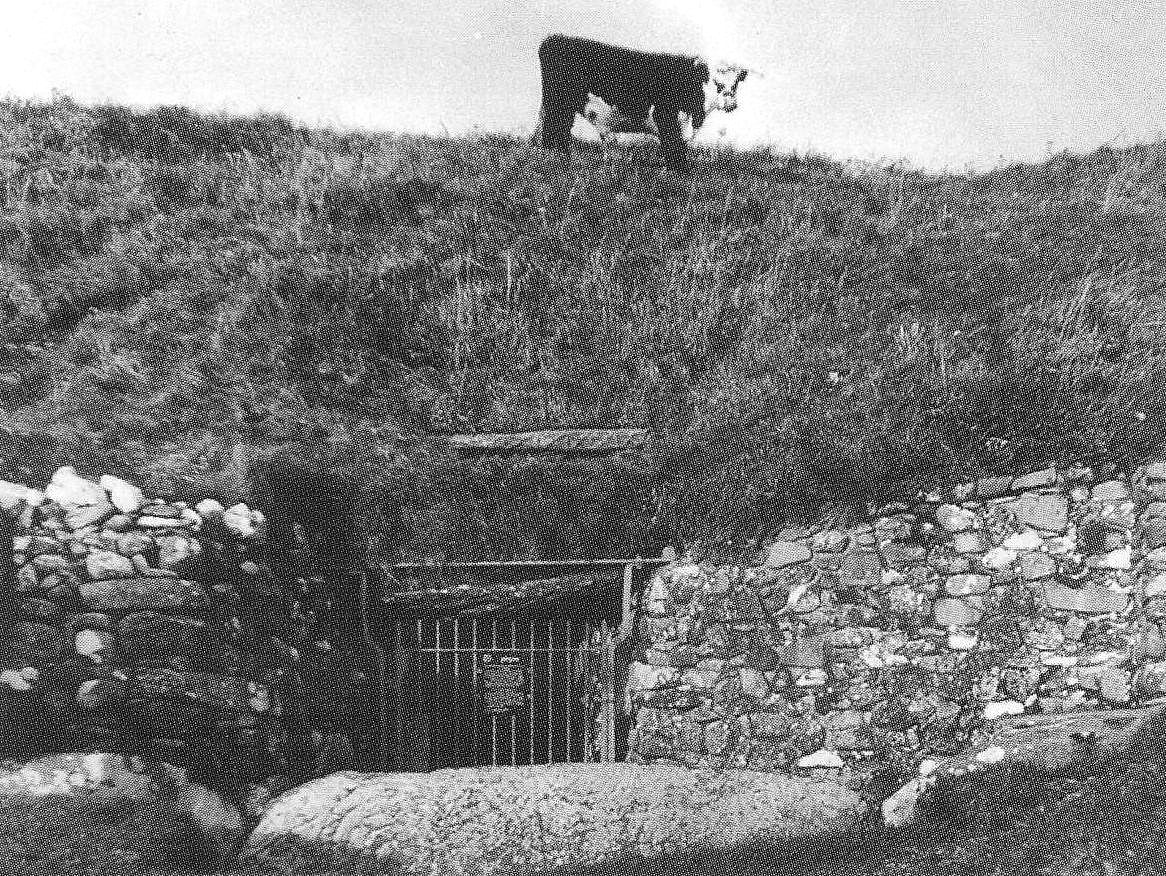
1950s: This photo illustrates the mounds appearance in the 1950’s prior to the start of archaeological excavations at the site in the 1960s (source).

1950s: A close up of the entrance into Newgrange prior to the 1960s excavations and the subsequent restoration work (photo OPW).

1967-67: These two image show the archaeological excavation underway at Newgrange (source). This extensive work was carried out between 1962 and 1967 under the expert direction of Professor M. J. O’Kelly. It revealed a wealth of information about the monuments origins and history. However, by its very nature is saw much of the mound material removed and this had to be reinstated after the archaeological excavation was completed.

1967-74: Works on repairing the mound and its surrounds began in earnest in 1967 and were not fully completed until 1974. This image shows the passageway being reconstructed and reinforced. Professor O’Kelly (second from the right) is pointing towards the roofbox (after Stout & Stout 2008, p. 47, fig. 30) .

1967-74: Probably the greatest change seen during these restoration works was the addition of 3 m high quartz wall to the front of the tomb. This addition to the monument was based on M. J. O’Kelly’s interpretation of the excavation results. He had discovered a thick layer of quartz stones spreading out in front of the tomb kerbstones for a distance of approximately 7 m, which he believed represented the remains of a collapsed wall. Thus on his advice a quartz facade was added to the tomb. However, as the quartz wall was deemed too unstable to support the weight of the cairn on its own, a 4 m high, reinforced steel and concrete wall had to be erected behind it. The quartz stones were then embedded into the concrete.
Not surprisingly this striking quartz wall caused much debate at the time and the arguments about its authenticity still rage on.
Further reading
Stout G. & Stout M. 2008. Newgrange. Cork University Press. Cork.




 ng and knitting. We will watch tweed weavers work magic at their looms, and Irish artists create with hand-dyed fleece. Interspersed will be visits to craft villages, galleries and ancient prehistoric and Celtic sites, and days of immersion creating our own art with the luscious Irish yarns and fleeces.
 Authentic Travel and Tours, LLC